


Ever been in a situation where you present your graphic design work to clients, only for them to turn up their nose and tell you it’s not what they were looking for?
Do you spend most of your time making one too many revisions to your work wondering why the client wasn’t more specific from the start?
Don’t be discouraged.
You probably don’t suck that bad at design (or maybe you do, we don’t know), but chances are it’s because you didn’t ask the right questions to get to know the client before you got started on the project. You’re way more likely to knock your projects out of the park when you get specific client input on project expectations.
In this post, we’ll cover why creating a graphic design questionnaire makes good business sense for the design process and we’ll share 30 questions you can ask in your questionnaire along with some tips.
You can ask these questions for many types of design projects including logo design, but if you want a questionnaire that’s more specific to logo design, check out our logo questionnaire post.

Content Snare is here to help you nail your next design project. Sign up to access our graphic design questionnaire template and save yourself lots of time prepping your own.
Here are 3 simple reasons why you want to use a questionnaire in your design process:
Now let’s get into what questions you can ask.

The first step to delivering appropriate quality graphic design work is to get to know everything about the client’s business and industry. Here are some questions you can ask about the company.
A brand is your client’s personality that needs to come across in all its marketing initiatives. Here are some questions you can ask to get a deeper understanding of the brand to best represent it.
We can’t stress enough how important asking these questions is. This section should take up the biggest chunk of your questionnaire. Be sure to ask your client for concrete visual examples of their ideas, what they like, and what they don’t like. The more input you can get here the better.
These questions help uncover how your client prefers to work with you and what their experience has been like in the past.
These questions get into the nitty-gritty to confirm the project scale, timelines, and project goals. You can take the answers to these questions to develop your creative brief.

Pretty straightforward questions here. Flat out ask them what they're willing to spend and if there’s any leeway. You can ask them to state a number or provide them with a range of options to choose from.
Now that you have an idea of what questions you can ask, how do you go about creating your questionnaire? Here are a couple of tools you can use to build one as well as some things to think about.
Google Forms and Gravity Forms are examples of online forms tools you can use to put together your research questionnaire. They are pretty easy to use but keep this in mind:
They’re a bit inconvenient for the client to fill out
Ideally, you want to make life as easy as possible for your clients. And when they use online forms like these, they have to submit all their answers to your questions in one go.
Saving their work and coming back to the survey later usually isn’t an option with these tools. This can be a setback for you since it can mean there will be delays in getting your answers back from them. This can slow down your design process.
You need to use email to follow up on form completion
The downside of using these online forms is that you’ll need to be on top of following up with your client over email to remind them to complete your survey. This can be a huge time suck!
When you use a tool like Content Snare that was purposely built to collect this kind of information, you avoid the two headaches mentioned above.
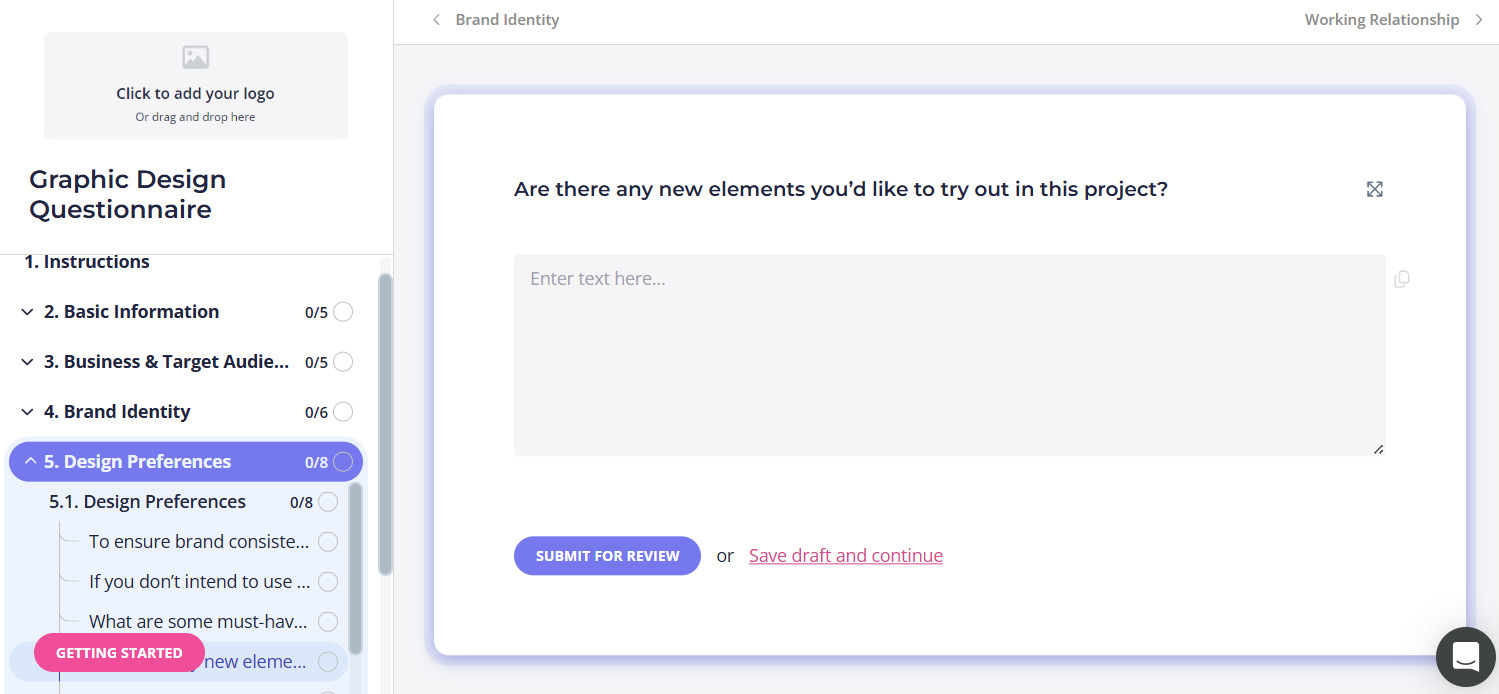
Source: Content Snare template library
Clients can fill out the questionnaire in pieces
When your client gets their questionnaire through Content Snare, they can answer as much of it as they want to, and come back to it later. Easy peasy. With an auto-save feature built into the forms, all information is saved and your clients can complete the form over multiple sessions, picking up where they left off last. This is how designers at 1000things explain it:
“The main benefit we get from Content Snare is that we save a lot of time and, above all, nerves. It was really stressing us out before Content Snare, having to write everything by email. Now, it’s like having a new employee who is helping us to ask for the data we need.”
You don’t need to use email to follow up
Content Snare cuts out the need for you to send email reminders. You can choose how often you want the platform to send your clients reminders then sit back and let it do the work for you. Content Snare will remind your clients to complete the questionnaire till all the information is complete and received.
Plus, Content Snare is ISO 27001 certified and uses military-grade encryption to protect sensitive client information, giving both you and your clients peace of mind.
We hope the questions and tools in this post have given you some helpful guidance on how to put together a solid graphic design questionnaire that will help you crush your next design project.
Are there any other questions you think are worth asking before taking up a graphic design project? Let us know in the comments!
Content Snare is here to help you nail your next design project. Sign up to access our graphic design questionnaire template and save yourself lots of time prepping your own.
You're already improving your processes, so why stop at your graphic design questionnaire? Here are a few others you might like:

Sylva Sivz is a seasoned copywriter here at Content Snare, based out of Vancouver, Canada. She has spent years working in agency environments and moonlights as a touring house DJ!


