


“The requirements weren’t clear.”
You’ve heard that before.
When a client ends up disappointed with the result of a project, it’s common for your team to say the requirements weren’t clear in defence (and honestly... most of the time they really weren't!)
It happens all too often and is frustrating for everyone involved. Delivering projects that miss the mark only means having to re-do all your work, and that can take ages!
So how can you avoid being in this awkward situation time and time again?
You nail the requirements from the very start.
In this post, we’ll share a 6-step requirements gathering process you can follow to cut out any false assumptions, make expectations crystal clear, and get everyone on the same page before you get started on a project.
Content Snare is a simple tool that helps you collect project requirements and files from clients easily for better project success. Just set up a questionnaire, send it to your client, and watch the requirements roll in.
Requirements gathering is a critical early phase in project management that involves identifying, documenting, and understanding the needs of your client. The main goal of requirements gathering is to define what the end product or solution must achieve.
If not done properly, it can interfere with project planning and ultimately lead to project management failures. As a matter of fact, industry reports show that requirements gathering is one of the most common causes of project failures, along with changing priorities and undefined risks and opportunities.

In very simple terms, requirements gathering (or requirements elicitation) means getting a complete understanding of what you’re supposed to be creating and why you’re creating it.
It can make all the difference in whether or not your project succeeds or fails.
The requirements gathering process involves interviewing the client as research, collecting necessary documents, and keeping a record of exact expectations and developments from the start to the finish of the project.
You need to go through the process whether your agency is building a website, landing page, social media strategy, content calendar, or any other project.
Research shows that more than 70% of failed projects miss the mark due to a lack of requirements gathering.
Based on this stat, you can assume that if you don’t bother to gather requirements effectively at all, you’re probably going to deliver a real mess!
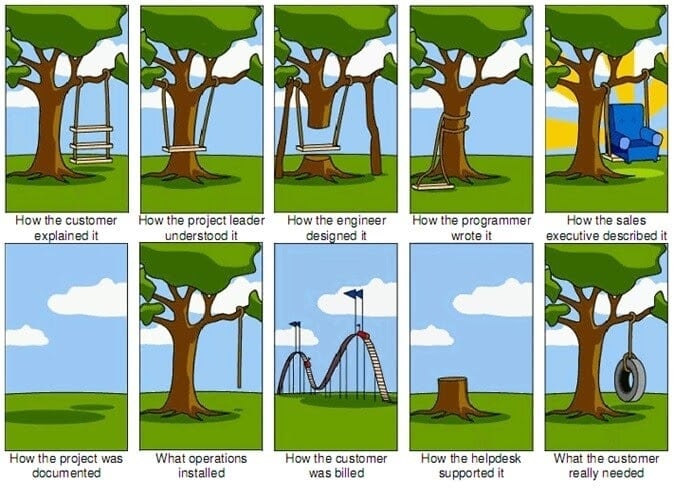
Here are a few things that can go wrong if you fail to gather requirements effectively. We’ll use a website design project as an example.
The client ends up asking for way more work than you first agreed to.
You thought you just had to design the pages in the main navigation, but found out the client wanted you to do all the pages. Not knowing the project’s exact requirements always creates scope creep.
Not having enough time, materials, or team members to get the work done.
Your web designer is also committed to another big project and is struggling to find the time to get all the pages done. This could jeopardize the entire project (or even multiple projects).

Experiencing delays and not meeting agreed on project deadlines.
Because your web designer could only work so many hours, they’re unable to meet the deadline. This means you can’t make the project timeline as agreed.
The client ends up paying more than they planned to. Clients thought they’d only be paying you $3K, but are now about to get slapped with a bill for $5K.
You deliver a project filled with issues or that doesn’t help the client achieve their goals. Here are two common examples:
Gathering project requirements varies from agency to agency (and from client to client), but there are some general rules everyone can follow.
Here are six steps you can take to successfully gather project requirements.
| Note: In putting together this guide, we reviewed case studies from agencies, consulted industry benchmarks in project management, and included lessons from more than 1,600 global Content Snare clients across industries like accounting, legal, real estate, and marketing. These insights shaped the 6-step process we’re about to share. |
The #1 thing to do before you start on any project is to define the project goal and share it with all project stakeholders. You might have had a good brainstorming session with your client, but never assume the project goal without confirming it first.
If you’re working on a website design, you’d be in big trouble if one person understood the goal to be to spread awareness, and another understood it to be to improve sales conversions!
An example of a project goal for a website design might be something like:
“Redesign the client’s website to generate more qualified leads for its new X service offering while reflecting new company branding imagery and guidelines.”
The more specific the project goal, the better. You can even go for SMART goals too (Specific, Measurable, Attainable, Relevant, and Timely).
The next most important thing to do is interview your client or project stakeholders and document everything that comes out of the conversation.
Once again, never assume you know what the customer wants, always ask!
For a website design, you may want to ask them things like:
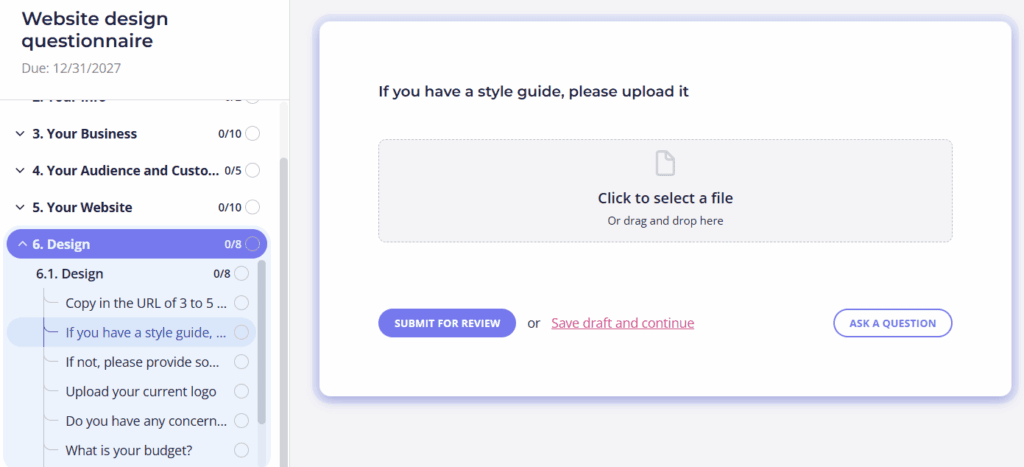
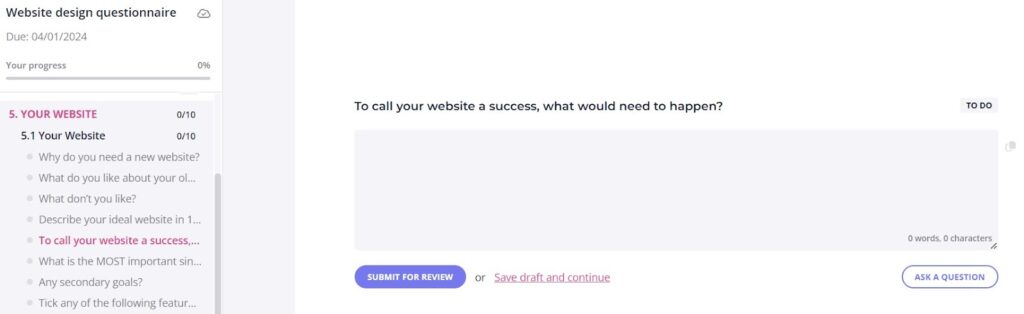
Source: Content Snare web design questionnaire
If you’re interviewing your clients in person, take detailed notes you can come back to. Better yet, you can make use of client questionnaires to gather all the background information you need digitally.
When you use Content Snare, you can collect text responses, logo files, images, and other files from your clients and store them all in one place.
Our tool helps you collect project requirements and files from clients easily for faster project progress. Just set up a questionnaire, send it to your client, and watch the requirements roll in.
The next thing to do is to organize and condense the information you discovered through your questionnaire and organize it into a creative brief. In our experience working with digital agencies, teams that get client sign-off on a detailed creative brief see up to 50% faster approvals and fewer mid-project disputes.
The creative brief will serve as the official document that guides the project from start to finish.
Your brief should outline your client’s:
You also use the brief to:
When you have the first draft ready based on your understanding of project expectations, schedule a meeting and walk your client through it. The first run-through might reveal misinformation that needs to be corrected.
When you figure this out by discussing the brief, you spare yourself a lot of headaches later down the road (Phew! Glad we did that).

After you’ve made as many revisions as needed to your brief, it’s time to get client-sign off.
You’ll now have a written agreement that project expectations were discussed in depth. This is your proof that everyone is on the same page and knows what to expect.
With expectations out in the open and everyone on board, it’s time to get to work and crush it.
Even when the project is done, there’s still an opportunity to reflect and improve on your processes. That is if you don't forget to document them.
After you’ve delivered a project, get together with your team and client and have a debriefing session.

Use this time to discuss what went well and what could have gone better. The feedback you get at this final step can help you improve your requirements gathering process even more.
Take the opportunity to learn from your mistakes, edit your process, and tweak your project management principles to get better results next time.
Improving your requirements gathering process will spare you disappointed clients and the time, energy, and resources it takes to correct your work if you get off on the wrong foot
Requirements gathering can be done in many different ways, but it mainly depends on the very nature of your business or your project management style.
Here’s a list of requirements gathering techniques you can use in the project initiation phase:

The most widely practiced technique is conducting one-on-one interviews with clients and/or other relevant stakeholders. This allows the project team to directly engage with the client, making it easier to identify crucial project elements.
These two represent essential techniques for requirements gathering in design, software, and product development projects. If you build visual representations of the proposed product, your clients can understand it better and provide feedback early in the process.

Brainstorming encourages creativity and innovative thinking. As a project manager, you can engage clients and team members in a free-flowing, open environment where they can generate ideas and discuss functional requirements.
Last but not least, questionnaires are effective for putting your client’s thoughts on paper in a highly structured manner. Today, you can find lots of tools for building forms and identifying project requirements — more about that in the next section.

Gathering requirements documentation is crucial to the success of your project. Chatting about project expectations in a meeting is one thing, but getting it in writing is another.
To help you out, Content Snare comes loaded with pre-written questionnaire templates. You can customize each of our 50+ online forms and use them as requirements gathering tools for all of your future projects.
Content Snare is trusted by more than hundreds of businesses worldwide, from bookkeeping firms to real estate agencies, and has been recognized on platforms like G2, Capterra, and the Xero App Store. The best thing about Content Snare is that you can test all of our templates for free, so go ahead and see how it can boost your project management efficiency
Our tool helps you collect project requirements and files from clients easily for faster project progress. Just set up a questionnaire, send it to your client, and watch the requirements roll in.
The main purpose of requirements gathering is to define what a project must achieve, ensuring scope, timelines, and budget are aligned before execution.
The most common techniques include client interviews, brainstorming workshops, prototyping, and structured questionnaires. Agencies increasingly use digital tools like Content Snare to automate and protect this process, due to its military-grade security and automatic request reminders.
Requirements gathering reduces misunderstandings and ensures projects are delivered on time and within budget by documenting client needs upfront. For instance, case studies show up to a 67% reduction in stalled projects when requirements are properly collected using Content Snare.

Sylva Sivz is a seasoned copywriter here at Content Snare, based out of Vancouver, Canada. She has spent years working in agency environments and moonlights as a touring house DJ!


