


Marketing often gets the spotlight, but daily operations and automation are where the real improvements happen when it comes to scalable growth in accounting. Creating smart and repeatable systems behind the scenes tends to unlock real potential for busy accounting teams.
But what’s the simplest way to do it?
That’s exactly what we explored in a recent session of the Content Snare AI & Automation Summit, where we heard from Paul Murray, co-founder of AccountKit. In this deep dive, we’ll unpack the session’s most valuable lessons.
Let’s take a look!
| About Paul Murray Paul Murray is the co-founder of AccountKit, a practice management platform built specifically for accountants and bookkeepers. Alongside his wife, he also helps run an accounting practice in Adelaide, where many of AccountKit’s tools were born out of real-world needs. Today, he’s focused on helping other firms improve efficiency, reduce stress, and reclaim time through small, strategic process improvements. |

Accounting firms are no strangers to software, but having the tools is not the same as using them effectively. In reality, many practices are weighed down by overlapping systems and a lack of internal consistency, all of which quietly erode productivity and margin. The challenge is not just technical - it’s also human.
With teams stretched thin and leaders balancing professional and personal responsibilities, making time to improve internal systems often falls to the bottom of the list. As Paul Murray noted during the session:
We often think that if we're gonna make a change, it has to be something substantial. Only the big changes really matter. But I'm here today just to challenge that as a notion.
Those big and transformative changes usually remain as ideas rather than actions, pushed aside by more urgent day-to-day demands. However, ignoring inefficiencies isn’t sustainable either because manual data entry and communication silos are too costly.
So, what’s the solution to this problem?
The cornerstone of Paul’s approach is something called the aggregation of marginal gains, or what’s more commonly known as the 1% rule. It’s a concept popularized by British cycling coach Dave Brailsford, who led his team to multiple Tour de France wins by focusing on tiny and incremental improvements across every part of performance.
For Paul, this idea is directly applicable to accounting:
It doesn't have to be big, it can be little changes each way out. The things we do many, many times. They don't necessarily seem that sexy when you talk about it, but they are things we do every time, multiple times a day.
By identifying daily inefficiencies and improving them just a little bit at a time, Paul and his team unlocked tens of thousands of dollars in additional capacity, and that’s before even factoring in advisory opportunities.

Before you can improve a process, you need to understand what’s slowing it down. There’s a whole series of challenges regularly seen across accounting firms, many of which stem from the same root issue: doing too much manually, with too little structure. Here are some of the main issues:
Fortunately, not every solution requires a complete systems overhaul: some tools are designed to address multiple pain points in one place.
Content Snare is a great example as it helps firms streamline one of the most frustrating and time-consuming parts of the client relationship: collecting information. With automated reminders, smart request builders, and consistent templates, Content Snare removes the back-and-forth email chains and reduces the need to chase clients manually:

Source: Content Snare template library
Everything stays organised in one secure client portal, so both clients and team members have clarity on what's needed, what's submitted, and what’s outstanding. The results speak for themselves: accounting practices that use Content Snare spend 71% less time gathering information from clients and see a 67% reduction in data collection costs, on average.
That’s a major efficiency win, particularly for firms looking to reduce admin without sacrificing client experience.
When firms start thinking about automation, it’s easy to assume the answer is buying new software. But one of the most important takeaways from Paul’s session is this: you likely already have the tools you need - you’re just not using them to their full potential.
That’s why we recommend starting by reviewing your current tech stack. In many cases, you can unlock huge gains simply by using your existing systems more intentionally. Take AccountKit as an example: this platform is packed with practical features designed to eliminate repetitive tasks and bring more structure into your day-to-day:
These are by no means flashy changes, but they solve the things accountants do dozens of times a day. As Paul put it during the session, it’s about focusing on “the stuff we do every single day,” and making those moments faster and more consistent.
The bottom line is that automation doesn’t have to mean transformation. Often, it just means tightening the bolts on what’s already there.
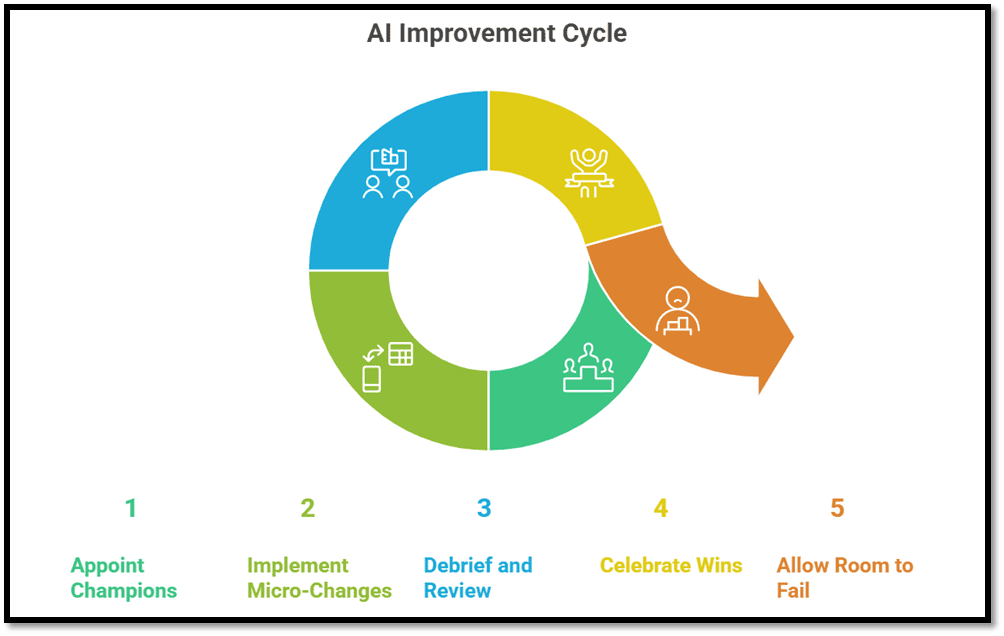
One thing to be aware of is that meaningful change only happens when the whole team is on board. In other words, successful automation isn’t just about technology, but rather about culture and building an environment that encourages small improvements. Here’s the simple but effective framework:
The key is to start small and stay consistent. This bottom-up approach allows change to happen gradually, without disrupting day-to-day operations.
The bottom line is that you don’t need a long-term roadmap or a full-time operations lead to start making meaningful improvements. What you do need is a commitment to focused changes and the consistency to let those improvements build over time. As Paul put it:
“You're gonna create this momentum as the team sees little changes, resulting in a tangible change to their day-to-day.”
Ultimately, automation in accounting isn’t about replacing people. It’s about helping your team spend more time on valuable and impactful work, and less time on repetitive tasks that slow them down.

Dražen Vujović is a journalist and content writer. More importantly, he is a father of two and a long-distance runner.


