


Getting the right information on time is crucial for all sorts of client-facing businesses, from accountants and lawyers to marketers and real estate agents. However, this process often turns into a seemingly endless cycle of unanswered emails, missing documents, and constant follow-ups.
The good thing is that modern data gathering methods eliminate the back-and-forth and encourage clients to provide what’s needed without the usual struggle. This post breaks down how to streamline client data collection and introduces a useful tool that does the heavy lifting for you.
Let’s take a closer look!

The usual way of collecting client information is a mess.
It starts with an email request, followed by silence. A few days later, another email. Then another. A response will come in eventually, but it will miss half the details or contain blurry photos taken on a phone of documents that should’ve been PDFs.
Collecting information from clients shouldn’t be that hard, but here’s why traditional methods create more problems than solutions:
With so many hurdles down the road, it’s clear that traditional data collection becomes a time-consuming and highly inefficient procedure.
Two mistakes are very common in client communication. One is to ask for too much information, while the other is to be unclear about what you want. That’s why you should take a moment to figure out what you really need before sending a request.
For instance, focus on the essentials and leave out optional information. If something isn’t important, don’t ask for it upfront. Besides that, using structured forms with predefined fields prevents confusion and helps to standardize responses.
Getting the right information starts with asking the right way — and that’s where a better system comes in.
Clients aren’t trying to make your life difficult on purpose, but delays are inevitable if your process for submitting information is confusing or clunky. The trick is to remove as much friction as possible so clients can provide what’s needed with ease.
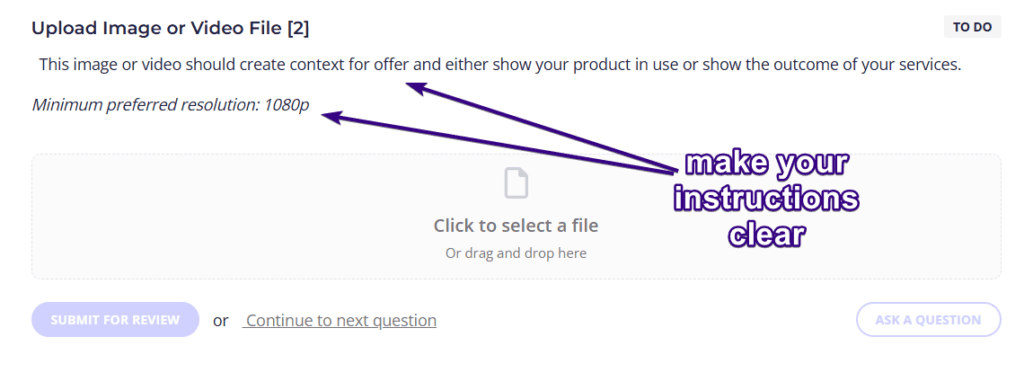
Source: Content Snare template library
Vague requests are genuine delay generators, so try to always include straightforward instructions. Here’s a simple example:
The point is to help clients know exactly what’s needed, the format it should be in, and how to submit it — no guesswork required.
Documents and information shouldn’t be scattered across email threads, text messages, shared drives, and messaging platforms. On the contrary, you should use a single structured system to keep everything in one place, so nothing gets lost or overlooked.
Related: 3 modern client communication tools that put email to shame
Clients usually don’t ignore requests because they feel like it — they forget. So, instead of manually chasing them down, you can set up automated reminders to nudge them at just the right time:
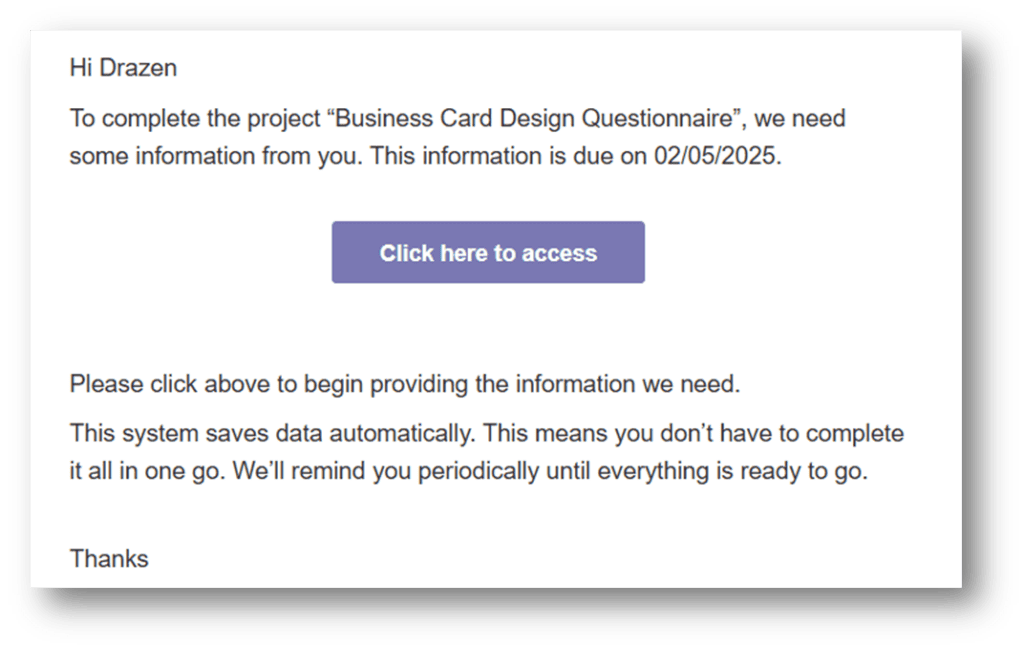
If you do it this way, there will be no more manual “just following up” emails.
If submitting information feels like a chore, clients will procrastinate. That’s why you should keep things intuitive, mobile-friendly, and easy to complete in one go. Here’s another example of how (not) to do it:
When you simplify the process, you also reduce friction and speed up response times, all without that annoying email back-and-forth.
A streamlined process is great in theory, but managing it manually is still a headache. The best way to truly remove friction is to use a tool that does the heavy lifting — automating requests, reminders, and file collection.
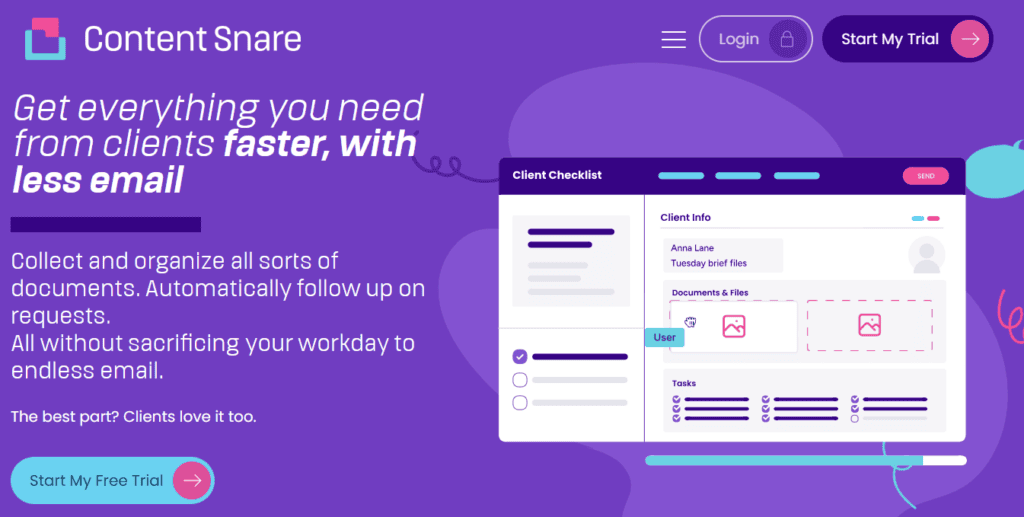
Content Snare eliminates the standard data collection headaches by automating pretty much the entire workflow. All it takes is to set up your communication preferences and let our tool do the rest. Here’s what makes Content Snare so efficient:
Thanks to these — and many other — features, Content Snare eliminates friction and makes data collection effortless. On average, our clients spend 71% less time gathering information and see a 67% reduction in stalled projects.
In a nutshell, Content Snare is a smart way to collect client info and documents. If you want to finally start saving precious time, give Content Snare a try right now. Sign up for a 14-day free trial and turn data collection chaos into organized bliss.

Switching from scattered emails and manual follow-ups to an automated system might feel like a big leap, but it’s actually easier than you think. The key is to introduce the change smoothly.
Here’s how to make the transition seamless:
Clients are creatures of habit, and any change (no matter how beneficial) can raise questions. In this case, you should make things simple and optimistic:
A quick welcome message explaining how the system benefits them (faster process, fewer emails, clear instructions) will smooth the transition.
The beauty of a structured system is that it’s flexible — you can quickly pinpoint obstacles and improve on your process.
If a certain request is causing confusion, tweak the instructions or field types. If a particular step feels unnecessary, remove it. Refining the process over time ensures it keeps working smoothly for both you and your clients.
Collecting client information doesn’t have to be a drawn-out process filled with confusion. A few simple changes like clear instructions and automated reminders can transform the entire information flow. The sooner you refine your approach, the sooner you can say goodbye to information-gathering chaos for good.

Dražen Vujović is a journalist and content writer. More importantly, he is a father of two and a long-distance runner.


