



HR professionals who want to hire and retain top talent need to keep an eye on the latest recruitment trends. That’s why agile teams look for data-driven insights and recruitment statistics to improve their hiring processes.
We’ve done the hard work by gathering up-to-date recruitment data and analyzing trends that shape the hiring landscape. Keep reading to see some of the latest recruitment stats that can help consolidate your hiring strategy.
First up, let’s have a look at the big picture. These general statistics focus on key hiring metrics and common industry challenges.
The industry is projected to grow at a CAGR of 12.7% from 2022 to 2030.
In addition, more than 50% of HR professionals say they struggle to hire their top choices before their competitors.
Low pay and benefits (44%) and poor work-life balance (43%) are also common reasons for quitting.
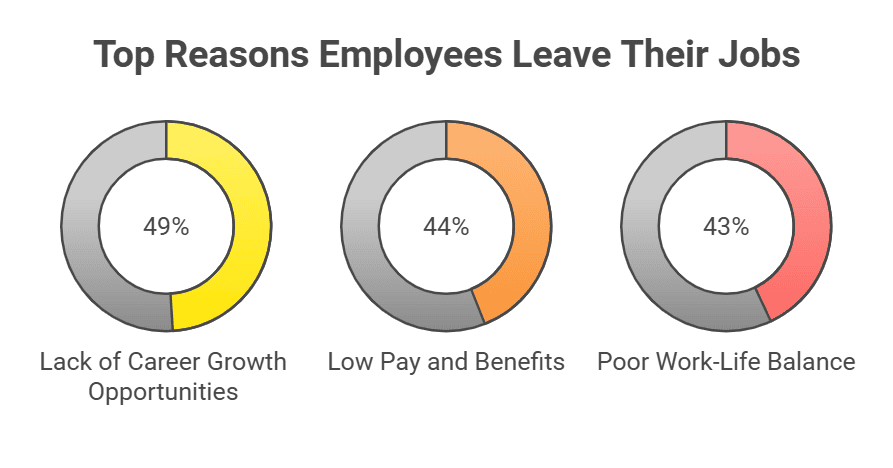
This figure clearly points out the importance of employee retention strategies. If you want to keep the best workers, you need to provide growth opportunities and create a healthy company culture.
It’s easy to draw the conclusion here — transparency and timely communication are a must in order to keep candidates engaged and reduce frustration during the hiring process.
The way you take care of a candidate’s experience can make or break the hiring process. In this section, we’ll show a few stats that reveal what job applicants really expect from HR managers.
61% of candidates said they had neutral experiences. However, 13% of them had such bad experiences that they’re less likely to apply again, refer others, or make purchases from the company.
On the other hand, candidates who are notified of their outcome are 3.5 times more likely to reapply to a different position with the same company.
The same percentage of candidates say that the lack of communication is the most frustrating part of the recruitment process.
Upfront transparency about pay is often a key factor in attracting candidates and building trust from the start.
As much as 39% of candidates also report being ghosted in the previous 12 months.
Modern recruitment is practically impossible without technology. The following stats explore how companies use tools like Applicant Tracking Systems (ATS) and other software solutions.
At the same time, the market is estimated to grow at a CAGR of 9.2% until 2031 and reach $5.58 billion.
Microsoft is the leading provider in the recruitment software sector (7.5%), followed by First Advantage, Sterling Talent Solutions, SAP, and Checkr.
ATS plays a major role in managing large-scale recruitment. Companies that use these platforms can streamline processes and make sure that the best candidates don’t slip through the cracks.
On the other hand, studies show that three-quarters of qualified candidates get rejected by ATS due to keyword mismatches or failure to meet specific criteria set in the job description.
Speed and efficiency are obviously critical in attracting the best candidates. Without ATS or streamlined hiring processes, employers risk missing out on top talent who move quickly through the job market.
Different industries face unique recruitment challenges. This section explores hiring trends, in-demand skills, and other important benchmarks across high-growth sectors like tech, healthcare, and education.
The overall employment in healthcare occupations is projected to grow much faster than the average for all occupations from 2023 to 2033.
On the downside, more traditional roles like computer programmers will be declining in the years to come (-10%), mainly due to automation and outsourcing.
This should lead to approximately 2.2 million additional jobs for vocational education teachers and university and higher education teachers.
However, many researchers claim that labor shortages are being driven by low wages and working conditions.
Manufacturing industries in particular are struggling to make themselves seem attractive to the next generation compared to high-paying (and more glamorous) roles in technology.
These statistics focus on emerging trends such as remote work, gig economy growth, and the preferences of younger generations entering the workforce.
In addition, the same portion of candidates believe that the application process will soon be so standardized that one click or swipe via smartphone will be sufficient to apply for a job.
More than 80% of them also believe that it will be necessary to analyze data in order to make good hiring decisions.
According to the Bureau of Labor Statistics, a lot of those openings come from the need to replace workers who transfer to different occupations.
Many HR professionals also believe that AI and technology adoption will cause the biggest disruption to the workforce in the next decade.
There seems to be a growing recognition of flexible work as a win-win because it increases both employee motivation and overall efficiency.
Recruitment statistics are more than just numbers — they are practical tools that can guide your hiring strategy. Our suggestion is to use these insights to find opportunities for improvement, so you can stay ahead in the race for top talent. Whether you’re refining your candidate experience, or testing recruitment software, the right data can assist you in attracting the best people for your team.

Dražen Vujović is a journalist and content writer. More importantly, he is a father of two and a long-distance runner.


