



You’ll often hear about conversion rate optimization (CRO) in the context of eCommerce, but it’s just as critical for digital agencies.
The only real difference is that agencies don’t focus on immediate sales. They need to refine their lead nurturing processes instead to turn prospects into long-term clients.
We caught up with Kurt Philip, founder of Convertica, to talk about conversion rate optimization (CRO) for digital agencies. With years of experience helping businesses fine-tune their websites, Kurt shares practical tips to boost client inquiries and ultimately increase conversions.
Here are some of the key takeaways from our conversation.
| Listen to the full podcast episode: Increasing your conversions with Kurt Philip |
CRO for digital agencies is the process of turning website visitors into paying clients, with a well-planned presentation of services. It’s a multifaceted process that involves building relationships, establishing trust, and optimizing lead generation for long-term and high-value services.
The goal of CRO is to ensure that every touchpoint — from the first visit to the inquiry stage — is designed to lead potential clients further into the funnel. Simply put, optimization should make the transition from prospect to client as seamless as possible.
Although CRO principles apply to both eCommerce and digital agencies, the approach is different due to the nature of the buying journey.
eCommerce customers make purchasing decisions quickly, so the focus of CRO is on optimizing the user experience to encourage immediate purchases. On the other hand, digital agency clients have a more complex decision-making process:
The bottom line is that agencies apply CRO strategies that align with their unique sales funnels and client relationships.
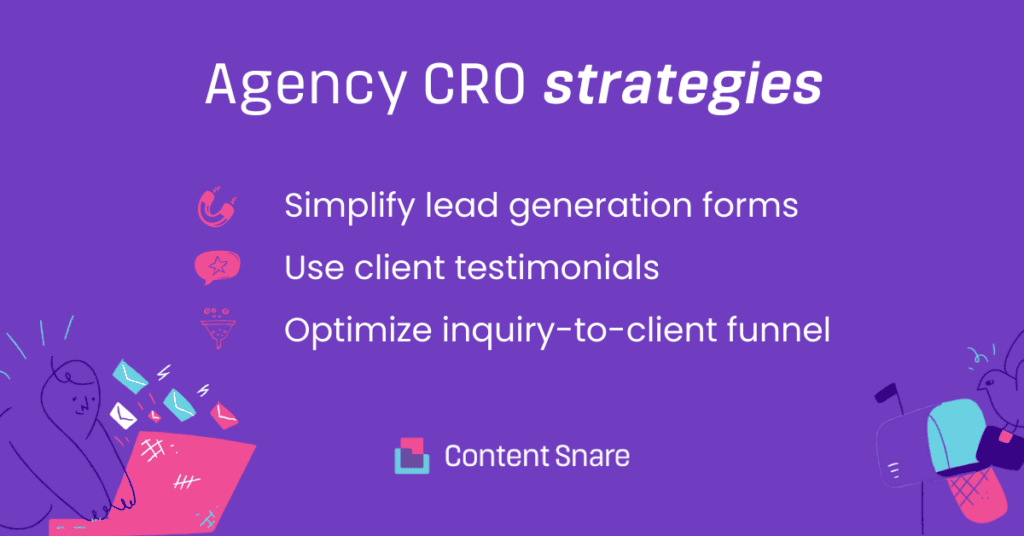
CRO is all about refining how potential clients move through the inquiry process, from the first visit, to the final contract. Here are some proven optimization strategies that digital agencies can use to grow conversions:
This is a critical suggestion because lead generation forms serve as the gateway for potential clients to get in touch. Don’t ask for too much information upfront — it will cause potential leads to drop off. A much better option is to prioritize simplicity, like this:
“It’s super surprising to see some huge websites that have like one very small CTA at the top and that’s it throughout the entire page.”
Trust is the cornerstone of agency conversions. Potential clients want to see valid proof that you can deliver results before they commit to working with you, and this is where client testimonials and case studies come in. Some of the best practices in this area include the following:
Kurt Philip claims that professional credibility is one of the most important aspects of agency CRO:
“80% of our homepage is basically trust-building stuff: testimonials, case studies, reviews. It’s all about building credibility.”
Your work truly starts once a potential client submits an inquiry. If you don’t want to lose prospects along the way, it’s important to optimize how you manage leads throughout the inquiry-to-client funnel. This means ensuring you do a few different things:
Agencies that build an effective funnel can quickly guide prospects through it. In the words of Kurt Philip:
“If there’s an agency with a very clear funnel, you’re going to need much less traffic than the eCommerce website that has 50 products where the traffic is split over the products.”

CRO cannot be productive without split testing (aka A/B testing). Split testing forces you to experiment with different versions of key website elements and determine which ones convert visitors into clients most effectively.
The beauty of split testing is that it removes the guesswork. Instead of assuming which element will perform better, you can rely on data-driven results. Kurt Philip claims that A/B testing helps to make Convertica so successful:
“I keep saying that we have a very high win rate… It’s because we always test everything with our clients because nothing is ever a hundred percent.”
The goal is to continuously refine your website and optimize it for higher conversion rates. For example, agencies should regularly test these elements:
Our suggestion is to focus on the pages that matter most. For instance, your homepage and service pages are the key points where conversions happen — testing and optimizing these pages may lead to big improvements.
Another tip is to test one element at a time. For instance, isolate one variable (like the CTA text) to accurately measure its impact. Testing multiple elements at once can muddy the results and make it difficult to determine what’s driving the improvement.
Finally, do not rush your tests. Do your best to gather enough data over a reasonable period to make sure that the results are statistically significant and not influenced by temporary fluctuations.
At its core, digital agency CRO is about making the path from inquiry to conversion as simple as possible. Though optimization strategies vary from one firm to another, the underlying principles remain the same — remove friction, build trust, and guide potential clients through a clear and engaging process.
As Kurt Philip puts it, the idea is to create a straightforward experience for your clients:
“Just make what you want them to do very clear. Make it as easy as possible even for a five-year-old to buy or purchase or sign up.”

Dražen Vujović is a journalist and content writer. More importantly, he is a father of two and a long-distance runner.


