


A successful agency isn’t the one that keeps landing new clients — it’s the one that keeps its work profitable. However, reports show that only 9% of agency leaders think they are “nailing” project profitability, while all the others believe they could do a lot better.
Many teams find themselves in a constant cycle of busyness — working long hours, closing deals, and delivering great work — yet their bank account tells a different story. So why does this happen? And more importantly, how can agencies fix it?
To answer these questions, we spoke with Marcel Petitpas, CEO and Co-Founder of Parakeeto. As an expert in agency operations and profitability, Marcel shares practical strategies for agencies to increase profit margins and stop leaving money on the table.
Let’s dive in!
| Listen to the full podcast episode: How to make your agency more profitable with Marcel Petitpas |
Too many agency owners assume that as long as revenue is growing, profitability will follow. But in reality, revenue alone doesn’t guarantee profit — especially in a service-based business.
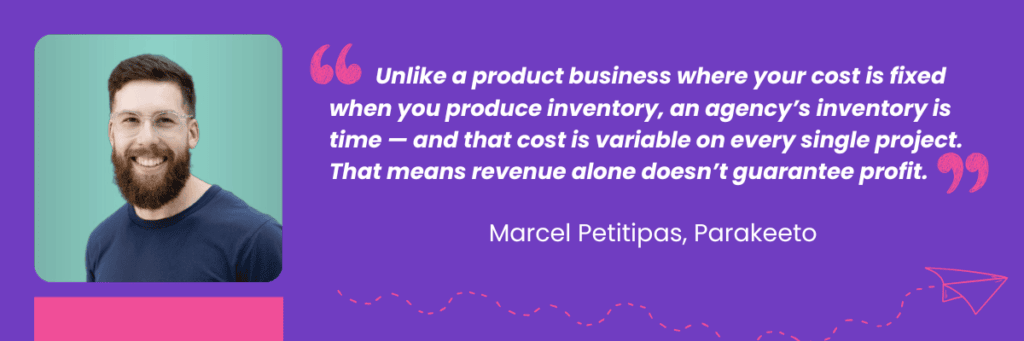
Unlike product-based companies, where costs are largely fixed once an item is produced, agencies operate in a dynamic cost environment. Every project requires variable amounts of time, resources, and team effort, meaning the actual cost of delivering a service can fluctuate significantly.
Profitability in an agency setting isn’t just about how much money comes in — it’s about how efficiently you earn it.
Factors like utilization rates, accurate project scoping, and effective time tracking play a critical role in ensuring that the work you do actually results in profit. Firms that fail to optimize these areas often find themselves busy, but broke.
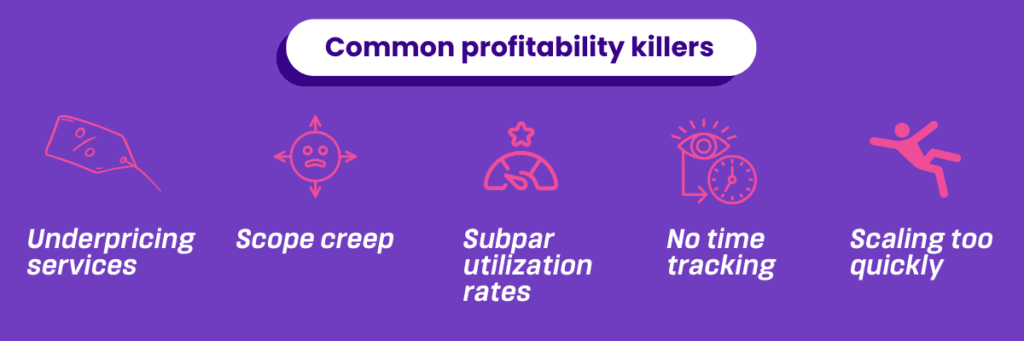
More often than not, the problem is that agencies focus on client acquisition and revenue growth while neglecting the operational efficiency and financial tracking needed to turn that revenue into actual profit.
Or, as Marcel puts it:
“So many agencies are great at doing creative work. So many agencies are great at marketing themselves. But when they go to their bank account, they don’t have any money. They’re struggling to make payroll. Why is this happening?”
Here are some of the biggest profitability killers:
Working harder isn’t how you solve these challenges. On the contrary, the point is to work smarter — as we’ll show in the following sections.
A common misconception among agency owners is that getting more clients will solve financial struggles. While increasing revenue is important, it doesn’t automatically lead to higher profitability, particularly if your internal operations aren’t optimized.
Here’s how Marcel Petitpas explains it:
“For some people, getting more clients could actually be the thing that kills their business. That's the danger of a service business — if your machine is not efficient, you can actually exacerbate cash flow problems.”
If your projects are underpriced, timelines are underestimated, or resources are stretched too thin, the result is higher costs, longer work hours, and tighter profit margins.
Two of the most critical metrics that drive profitability are utilization rate and time tracking.

In simple terms, utilization rate measures how much of an employee’s time is spent on billable work versus internal meetings, admin, or unproductive hours. For instance, high-growth agencies aim for 80–95% utilization for billable roles.
Agencies that fine-tune scheduling and reduce wasted time can significantly boost profitability without adding more clients. Even a small improvement in utilization can have a serious impact on the bottom line. Or, as Marcel puts it:
“A 5% increase in utilization could result in a 50–80% increase in bottom-line profitability. That’s the power of small changes.”
On the other hand, accurate time tracking is the foundation of improving utilization and overall profitability. Without clear data on how long projects actually take, your agency will likely struggle with underpricing, missed deadlines, and inefficiencies.
Agency owners often resist time tracking because they fear it will feel restrictive or create unnecessary admin work. However, when done right, time tracking empowers teams by providing insights into where time is being lost and which projects are profitable.
As Marcel puts it:
“Time tracking isn’t about micromanaging — it’s about making better business decisions and preventing burnout.”
When agencies focus on utilization and time tracking, they gain full control over their profit margins. Here are a few simple ways to do that:
Of course, time tracking and utilization alone aren’t enough — you should also analyze how your projects perform compared to their original estimates. If you’re not tracking where time and resources are going, you’re likely losing money without realizing it.
As Marcel explains:
“Every time you quote work for a client, you’re making assumptions. If you’re not measuring the difference between your assumptions and reality, you have no way of improving your process or predicting profit.”
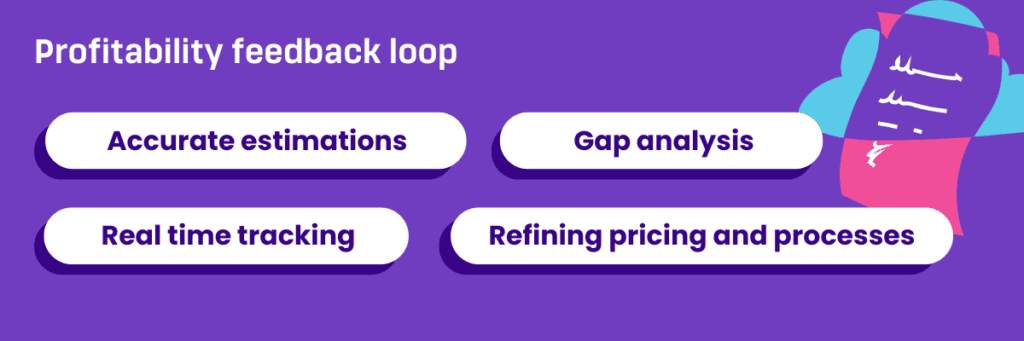
This is where the profitability feedback loop comes into play. Agencies that consistently track and refine their processes are much better at reducing inefficiencies. The feedback loop typically features the following steps:
Agencies that implement this system — instead of relying on guesswork — gain better predictability and healthier cash flow, all without taking on more clients or working more hours.
Improving agency profitability might seem overwhelming at first, but it doesn’t require a massive overhaul. On the contrary, it’s all about making small and intentional changes that add up over time — track time a little more accurately, refine pricing just slightly, and increase team utilization by even a few percentage points.
“When you take the time to focus on profitability, the impact on the bottom line is unbelievable.”
- Marcel Petitpas

Dražen Vujović is a journalist and content writer. More importantly, he is a father of two and a long-distance runner.


